The Background Story
The story of TXB Group and Diakonie Broumov serves as an example of a functioning circular economy model that connects research, innovation, and the social dimension of business. The project confirms that even material long considered waste can become the foundation for a new product with high added value—while simultaneously contributing to solving today’s environmental challenges.
From Textile Waste to Innovative Building Material
TXB Group develops structural boards from recycled textiles—material that would otherwise end up in landfills or incinerators. A key partner in the project is Diakonie Broumov, which has long operated a network of used textile containers and managed the sorting process. It was here that the need arose to find a new use for the portion of material no longer suitable for wearing or other conventional processing.

The result is the TXB board production technology—a solid structural material usable, for example, in construction or interior design. The project represents a concrete demonstration of the circular economy in practice, where textile waste is reintroduced into circulation as a functional product.
The first sorting line processes approximately 10,000 tons of textile waste annually.

Pavel Hendrichovský
Managing Director of TXB Group
Another significant milestone was the opening of the first production line in Broumov, which enables the systematic processing of textile waste into insulating construction boards. The project thus demonstrates that innovative solutions can emerge even in smaller regions while maintaining international ambitions—the company also presented its technology during a trip to Japan.
A Collaboration Growing Step by Step
Our collaboration with TXB Group and Diakonie Broumov has gradually developed across several levels. Through a collaborative research program, we connected the company with the Technical University of Liberec, where the development of the boards’ material properties took place. In 2024, we nominated the company for a meeting of innovative firms with the President of the Czech Republic, Petr Pavel, where they had the opportunity to present their project as an example of a technological solution with export potential.
Based on our recommendation, TXB representatives met with President Petr Pavel.
In the area of sustainability, we are also establishing cooperation through an upcoming decarbonization program focused on the product’s LCA analysis in collaboration with CTU. This step will help the company evaluate the environmental impacts of production in detail and prepare documentation for further product development in line with sustainable construction principles.
Technology That Inspires Other Companies
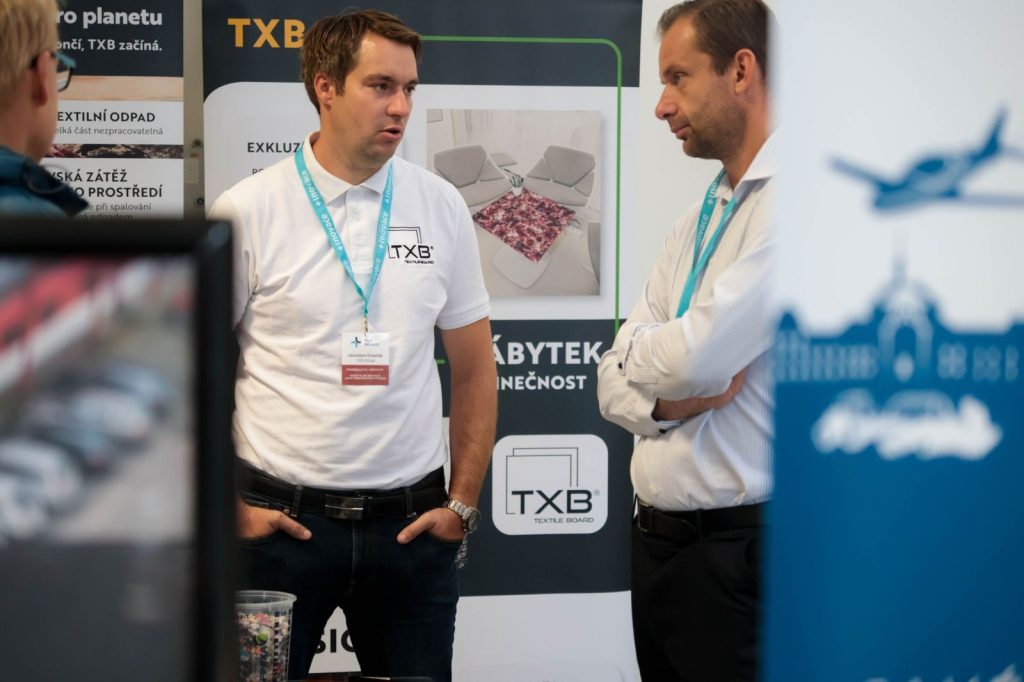
TXB Group regularly presents its technology to both professional and general audiences. The company participated in the NOVO EXPO +inovace 2024 and 2025 editions, where it had the opportunity to present its solutions to more than two thousand visitors annually, and its participation is also planned for 2026. It actively shares its experience at professional conferences and educational events focused on sustainable construction, the circular economy, and innovation.
The company’s managing director, Pavel Hendrichovský, was also a guest on our podcast “Lighting up Science and Innovation in the Hradec Králové Region,” where he focused primarily on raising awareness about the textile industry and ecological clothing recycling among the general public.
Listen on:
The company also participated in our TalentHUB +inovace Academy, allowing one of the talents to complete job shadowing directly within the textile sorting and TXB board production operations. The project thus inspires not only the professional public but also the upcoming generation of technological entrepreneurs.
The Circular Economy as a Common Theme
The connection between TXB Group, Diakonie Broumov, and Plus inovace shows that the circular economy is not just a theoretical concept, but a concrete system of cooperation between companies, research institutions, and educational programs. The project proves that innovation can emerge gradually—through a combination of research, technological development, and the sharing of experience.

We are delighted to be part of a story that shows how waste can be transformed into a source of new value, and how solutions with international impact can emerge even in a regional environment.